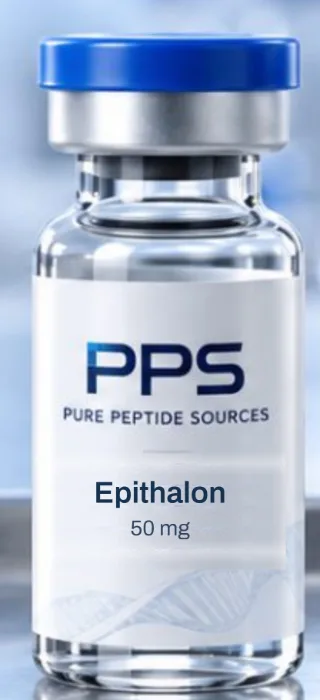
Epithalon
50 mg
Tetrapeptide pineal bioregulator, 50 mg per vial.
- Sequence
- AEDG
- Storage
- Refrigerated
Comparison
The two most-requested compounds in longevity research, arrived at from completely different directions: one from pineal gland extract work, the other from reading the mitochondrial genome.
They address longevity from opposite ends. Epithalon belongs to the bioregulator tradition and is studied for telomerase and circadian endpoints. MOTS-c is a mitochondrial-derived peptide studied for metabolic signalling, and is as much a metabolic compound as a longevity one. Researchers running both are usually covering two distinct hypotheses rather than reinforcing one.
| Property | Epithalon | MOTS-c |
|---|---|---|
| Origin | Developed from pineal gland extract research | Encoded in mitochondrial DNA |
| Length | Tetrapeptide, AEDG | 16 residues, MRWQEMGYIFYPRKLR |
| Molar mass | 390.3 g/mol | 2174.6 g/mol |
| Primary pathway studied | Telomerase expression, circadian regulation | AMPK signalling, glucose handling |
| Research domain | Senescence and telomere biology | Metabolic and exercise-response models |
| Compound family | Khavinson bioregulator series | Mitochondrial-derived peptides |
| Price | $82.00 · 50 mg | $76.00 · 10 mg |
50 mg
Tetrapeptide pineal bioregulator, 50 mg per vial.
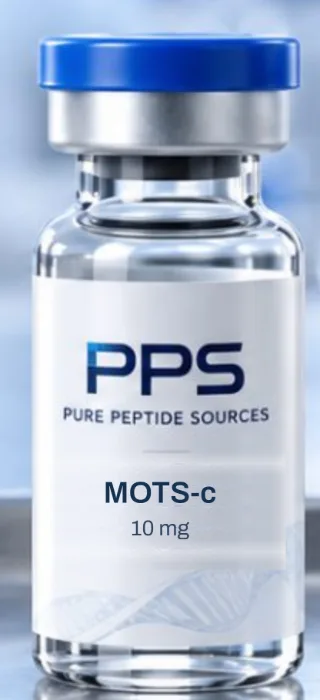
10 mg
Mitochondria-derived 16-amino-acid peptide, 10 mg per vial.
It is encoded in mitochondrial DNA rather than nuclear DNA, which made it one of the first identified mitochondrial-derived peptides and opened a category that now includes humanin and others.
A family of very short peptide bioregulators, typically two to four residues, each associated with a specific tissue type. Epithalon is the pineal member and the most widely studied of them.
Often, because their mechanisms do not overlap. One targets telomere and circadian endpoints, the other metabolic signalling, so a combined protocol tests two independent hypotheses rather than one.
All products listed are sold strictly for in-vitro laboratory research and analytical use. They are not drugs, foods, cosmetics or medical devices, and are not intended to diagnose, treat, cure or prevent any disease.
PPS assistant
Catalogue, handling, shipping and payment
Research use only. No dosing or medical advice. A person: Info@purepeptidesources.com