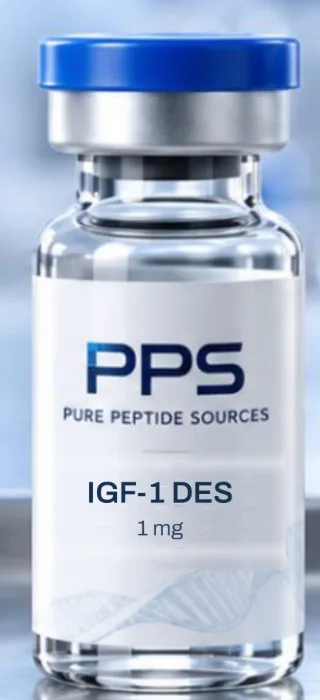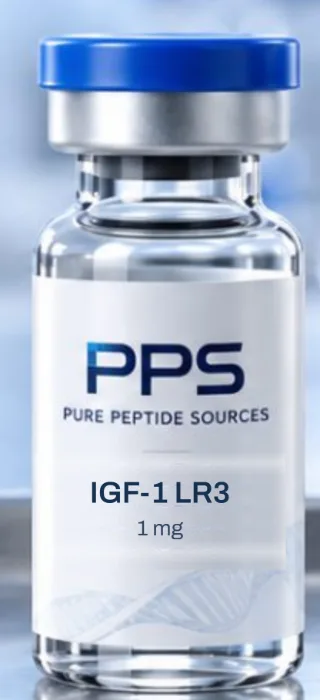
IGF-1 LR3
1 mg
Long Arg3 analogue of insulin-like growth factor 1, 1 mg per vial.
- Storage
- Refrigerated
Comparison
Two modifications of insulin-like growth factor 1 that pull in opposite directions. Both reduce binding-protein affinity; one extends the exposure window dramatically, the other collapses it.
The modifications answer two different research questions. LR3 is the one for sustained systemic exposure, because the extension and substitution together keep it circulating far longer than the native protein. DES is the one for a short, local signal, and the fact that both achieve their result by reducing binding-protein affinity is what makes the pair useful for isolating the role of those binding proteins.
| Property | IGF-1 LR3 | IGF-1 DES |
|---|---|---|
| Modification | 13-residue N-terminal extension plus an Arg3 substitution | First three N-terminal residues removed |
| Molar mass | 9111 g/mol | 7371 g/mol |
| Binding-protein affinity | Sharply reduced | Sharply reduced |
| Exposure | Long, substantially beyond native IGF-1 | Short and local |
| Studied for | Sustained systemic IGF signalling | Localised, time-limited signalling |
| Potency at receptor | Comparable to native IGF-1 | Reported higher than native IGF-1 in vitro |
| Price | $46.00 · 1 mg | $46.00 · 1 mg |
1 mg
Long Arg3 analogue of insulin-like growth factor 1, 1 mg per vial.
1 mg
Truncated IGF-1 lacking the first three residues, 1 mg per vial.
Long Arg3: a 13-amino-acid N-terminal extension combined with an arginine substitution at position three. Together they sharply reduce binding-protein affinity and extend circulating half-life.
DES(1-3) refers to the removal of the first three N-terminal residues. The truncation reduces binding-protein affinity and produces a short, locally acting profile.
Neither. Both are engineered specifically to escape the binding proteins that regulate native IGF-1, which is the property the native molecule has and both variants deliberately lack.
All products listed are sold strictly for in-vitro laboratory research and analytical use. They are not drugs, foods, cosmetics or medical devices, and are not intended to diagnose, treat, cure or prevent any disease.
PPS assistant
Catalogue, handling, shipping and payment
Research use only. No dosing or medical advice. A person: Info@purepeptidesources.com