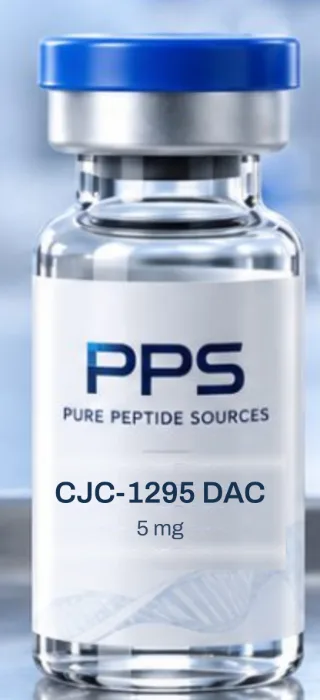
CJC-1295 DAC
5 mg
GHRH analogue with drug affinity complex, 5 mg per vial.
- Storage
- Refrigerated
Comparison
The same GHRH analogue in two forms. The drug affinity complex is the only difference, and it changes the exposure profile from a pulse measured in minutes to sustained elevation measured in days.
This is a choice about exposure pattern, not about strength. The DAC form holds levels elevated continuously, which suits research into sustained receptor occupancy. The no-DAC form produces a discrete pulse that resembles the body's own release pattern, which is what makes it the right one when pulsatility itself is what is being studied.
| Property | CJC-1295 DAC | CJC-1295 |
|---|---|---|
| Drug affinity complex | Present, a maleimidoproprionic acid group | Absent |
| Albumin binding | Binds serum albumin | Does not bind |
| Exposure profile | Sustained elevation over days | Short pulse over minutes |
| Molar mass | 3647.2 g/mol | 3367.9 g/mol |
| Also called | CJC-1295 DAC, long-acting GHRH | Modified GRF 1-29, mod GRF |
| Studied where | Sustained receptor exposure is the variable | Pulsatility is the variable |
| Price | $65.00 · 5 mg | $52.00 · 5 mg |
5 mg
GHRH analogue with drug affinity complex, 5 mg per vial.
5 mg
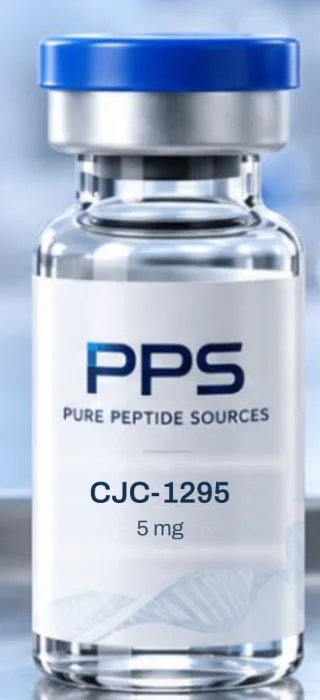
Modified GRF 1-29 without drug affinity complex, 5 mg per vial.
Drug affinity complex. It is a maleimidoproprionic acid group that binds serum albumin, which extends circulating half-life from minutes to days.
Yes. The two names describe the same molecule: a GHRH 1-29 fragment with four amino acid substitutions for stability and no albumin-binding complex attached.
Natural growth hormone release is pulsatile rather than continuous. Where a research design needs to preserve that pattern, sustained elevation would confound the result, so the no-DAC form is used.
All products listed are sold strictly for in-vitro laboratory research and analytical use. They are not drugs, foods, cosmetics or medical devices, and are not intended to diagnose, treat, cure or prevent any disease.
PPS assistant
Catalogue, handling, shipping and payment
Research use only. No dosing or medical advice. A person: Info@purepeptidesources.com