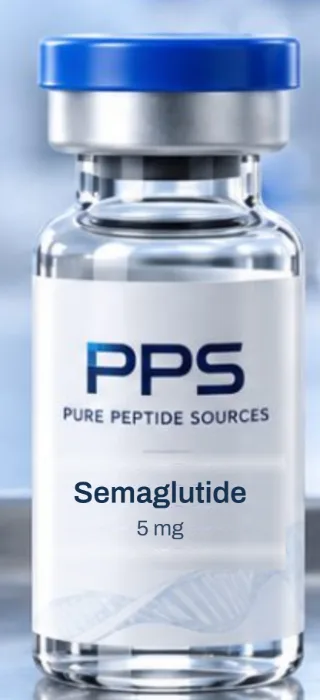
Semaglutide
5 mg
Long-acting GLP-1 receptor agonist, lyophilised, 5 mg per vial.
- CAS
- 910463-68-2
- Storage
- Refrigerated
Comparison
The two most-searched compounds in metabolic research. The difference is not potency at a shared target, it is the number of receptors involved: one acts at a single incretin receptor, the other at two.
Semaglutide is the baseline: it isolates GLP-1 receptor activity, which is what makes it the control in nearly every incretin study. Tirzepatide adds GIP, so it is the compound to use when the research question is specifically what the second receptor contributes. Comparing them is how the GIP contribution gets measured at all.
| Property | Semaglutide | Tirzepatide |
|---|---|---|
| Receptor targets | GLP-1 only | GIP and GLP-1 |
| Class | Single agonist | Dual agonist |
| Backbone | GLP-1 analogue, 31 residues | GIP-based sequence engineered for dual affinity |
| Molar mass | 4113.58 g/mol | 4813.45 g/mol |
| Half-life strategy | C18 fatty diacid chain, albumin binding | C20 fatty diacid chain, albumin binding |
| Role in research | The reference incretin comparator | The dual-agonist comparator |
| Price | $55.00 · 5 mg | $85.00 · 10 mg |
5 mg
Long-acting GLP-1 receptor agonist, lyophilised, 5 mg per vial.
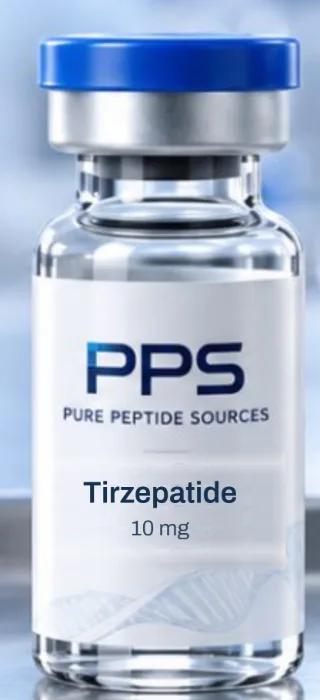
10 mg
Dual GIP and GLP-1 receptor agonist, 10 mg per vial.
No. It acts at an additional receptor. Tirzepatide is a dual GIP and GLP-1 agonist, while semaglutide acts at GLP-1 alone, so the difference is mechanistic rather than a matter of relative strength at one shared target.
GIP is the other major incretin hormone. Recruiting it alongside GLP-1 produced larger effects in metabolic models than GLP-1 agonism on its own, and isolating that contribution is the reason the two compounds are studied against each other.
Semaglutide. It established the long-acting GLP-1 analogue as the reference compound, and the dual and triple agonists were developed afterwards against that benchmark.
All products listed are sold strictly for in-vitro laboratory research and analytical use. They are not drugs, foods, cosmetics or medical devices, and are not intended to diagnose, treat, cure or prevent any disease.
PPS assistant
Catalogue, handling, shipping and payment
Research use only. No dosing or medical advice. A person: Info@purepeptidesources.com